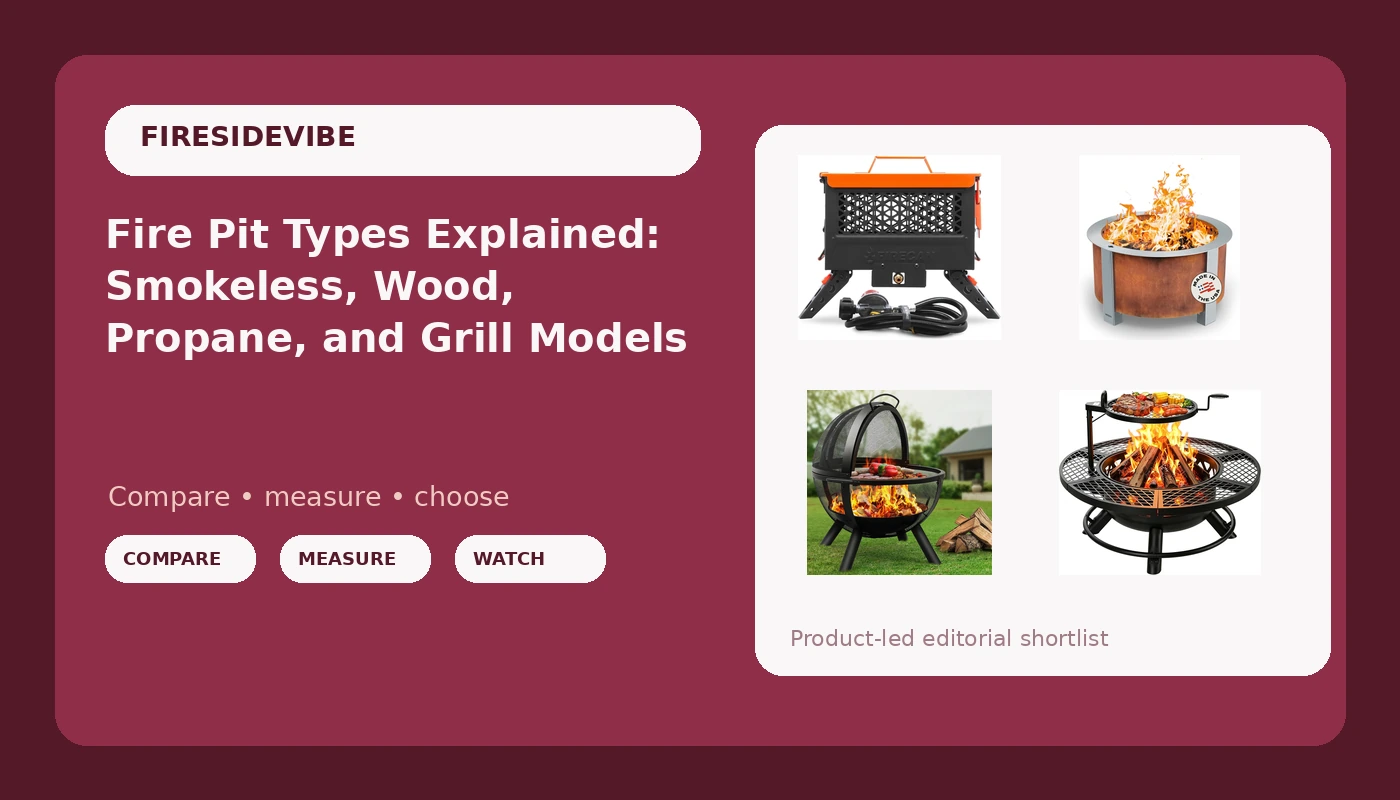
Most fire pit purchases go sideways in the same place. The buyer picks a shape and a finish, gets it home, and then finds out the hard way that the thing smokes them out of their own seating area, or that it looks tired by the second spring. Getting fire pit types explained by fuel and airflow instead of by styling is the version of the decision that actually holds up over a few seasons. Four models cover most of the ground here: a corten steel pit sold as a smokeless design, a traditional wood bowl that ships with a poker, a portable propane unit with its own hose and regulator, and a round ball shaped pit with a grill built into it. They are not interchangeable. The differences come down to three questions you can answer before you spend anything: what you burn, where the pit lives, and whether you intend to cook over it.
Related: How to Keep a Fire Pit From Smoking You Out →
Quick answer
Settle the fuel question first, then the footprint. If you burn wood in one fixed spot and want less smoke drifting into your chair, a pit sold as a smokeless design is the right shape of purchase. If you want a traditional open fire and a tool to tend it, a classic wood bowl with a poker covers it. If wood is not allowed where you live, or you want flame without ash and cleanup, a propane unit with an included hose and regulator is the direct answer. And if the fire is also your cooking surface, a pit with a built in grill earns its space. The finish, the lid, and the accessories are details you settle after the fuel question is answered, not before.
Four useful options
| Model | Best fit | What stands out |
|---|---|---|
| Breeo X Series 24 - Corten Steel Smokeless Fire Pit for Outside - 27.5 in | A permanent backyard pit for people who want to keep burning wood | Corten steel body in a 27.5 inch size, sold under a smokeless design |
| Bali Outdoors Fire Pit with Poker | Traditional wood fires in one fixed spot | Wood burning bowl that includes a poker for tending logs |
| Ignik FireCan Portable Propane Fire Pit with Hose and Regulator | Patios, rentals, and campsites where wood is not an option | Propane fuel with the hose and regulator included in a portable body |
| Ikuby Ball of Fire Pit fire Ball with BBQ Grill fire Globe Pit Large Round fire Pit,Patio Fire Pit Fireplace for Camping, Heating, Bonfire and Picnic, Black, 33.8532.6735in, (BLKFP-001) | Cookouts where the fire doubles as the grill | A built in BBQ grill inside a round, ball shaped body |
The smokeless wood pick: Breeo X Series 24 - Corten Steel Smokeless Fire Pit for Outside - 27.5 in
This is the top of the range in this group, and the trade off is straightforward. You pay for the smokeless design and the material, and you get a pit that wants to stay put. It is not something you carry to a tailgate. If you want a fire you can move, look further down this page. If you want one fire pit that sits in the same corner of the yard for years and does not smoke you indoors on a still night, this is the category to shop in.
The classic wood pick: Bali Outdoors Fire Pit with Poker
A conventional wood bowl is the pit most people picture when they picture a fire pit, and it comes with the honest version of the experience. You get the smell, the crackle, and the smoke. Nothing here promises to eliminate that. What you should check on any pit in this category is whether it has a spark screen or a way to add one, because an open bowl on a wooden deck is an ember waiting for a breeze.
The propane pick: Ignik FireCan Portable Propane Fire Pit with Hose and Regulator
Be clear about what you are buying. A propane pit gives you flame, warmth, and instant shutoff. It does not give you a campfire. If your reason for wanting a pit is the ritual of building and feeding a fire, this will feel like a substitute. If your reason is that you want to sit outside in the evening and not smell like a chimney afterward, or your neighborhood bans wood burning during dry stretches, propane solves a problem wood cannot.
The grill combo pick: Ikuby Ball of Fire Pit fire Ball with BBQ Grill
Combination pits ask for one compromise and reward you with one convenience. Cooking over a fire means you are managing heat for two jobs at once, and a grate that sits over an active fire needs attention the whole time it is loaded. In exchange, a cookout and a fire night become the same event. If your household already owns a grill, this is redundant. If it does not, this covers both without a second footprint.
Prices and availability may change. Product images, names, and retailer links are matched to verified listings. No current price, rating, stock status, or measured result is stated here without current evidence.
What "smokeless" actually means
A smokeless fire pit is not a pit that produces no smoke. It is a pit designed to burn more of the smoke before it leaves the body. The usual approach is a second combustion zone: the fire sits in an inner chamber, and the hot gases that would otherwise drift up as visible smoke get mixed with preheated air and burned again higher in the pit. That is the secondary burn, and it is why these pits tend to run hotter and cleaner once they are up to temperature.
Two practical consequences follow. First, a smokeless design does most of its work when the fire is established and hot. A cold start still smokes. Second, fuel quality matters more, not less. Wet or green wood puts out far more smoke than the secondary burn can consume, so a smokeless pit loaded with damp logs behaves like any other pit. Seasoned, dry wood is the difference between the feature working and the feature being a marketing line.
Wind is the third variable. Even a well designed pit will push smoke toward one side of the seating circle when the breeze decides to change direction. That is airflow, not a defect, and it is why seating layout matters as much as the pit itself.
Fuel, footprint, and permanence
Wood, propane, and combination pits are three different purchases wearing similar shapes.
Wood gives you the full experience and asks for the most work: sourcing dry fuel, building the fire, managing embers, and cleaning ash. It also delivers heat that radiates and smells like something. If you want the fire itself to be the event, wood is the honest choice.
Propane gives you flame on demand with a shutoff valve. There is no ash, no spark shower, and no burn ban problem in most cases, because there is no wood smoke. In exchange, you trade the ritual and you trade some of the radiant feel. A propane flame is a controlled appliance, and it feels like one.
The footprint question is separate and just as important. A corten steel pit at 27.5 inches and a ball shaped pit near 34 inches across both want a dedicated spot. A portable propane unit wants a spot it can leave. Decide whether the pit is furniture or equipment. Furniture stays where you put it and should be chosen for the yard. Equipment travels and should be chosen for the trips.
Material follows from that. Corten steel is specified on pits meant to live outside permanently because it weathers into a stable surface rather than flaking away, which is why it shows up on premium outdoor pieces. Painted or thinner steel can serve fine indoors-adjacent patios and covered spaces, but it is the material that decides whether a pit looks the same in year five.
- Decide what you burn: wood for the experience, propane for convenience and rule compliance.
- Decide whether the pit stays in one place or travels with you.
- Check the size against your actual seating circle, not the picture on the box.
- Confirm there is a spark screen or a way to add one before the pit goes near a deck.
- Read the material description and ask whether it will survive a full season of weather.
Before you buy: the practical checks
- Give the pit a non combustible base. Gravel, stone, or a paver pad under the pit protects the surface beneath it and keeps embers off anything that can catch.
- Keep clearances real. Distance from railings, siding, low branches, and furniture is the difference between an evening and an insurance claim.
- Buy dry, seasoned wood. It is the single biggest lever on smoke, and no secondary burn design compensates for wet fuel.
- Check local rules before you commit to wood. Fire bans, apartment policies, and HOA restrictions often decide the fuel question for you.
- Cover or store the pit when it is not in use. Weather is what ages a fire pit, and a cover is cheaper than a replacement.
Which option should you choose?
Choose the Breeo X Series 24 - Corten Steel Smokeless Fire Pit for Outside - 27.5 in when you burn wood in a permanent backyard spot and want the smoke managed by design. Choose the Bali Outdoors Fire Pit with Poker when you want the traditional open fire, a tool to tend it, and a straightforward wood bowl. Choose the Ignik FireCan Portable Propane Fire Pit with Hose and Regulator when wood is not allowed or not wanted, and you would rather have flame on demand with no ash. Choose the Ikuby Ball of Fire Pit with BBQ Grill when the fire and the cooking surface should be the same object.
The caveat worth repeating: none of these listings was tested here, and no performance claim on this page goes beyond what the product names and listings state. Smokeless means a design approach, not a guarantee, and propane means convenience, not a campfire.
The bottom line
Fire pit shopping is a fuel decision dressed up as a style decision. Wood gives you the real thing with real smoke and real work, and a pit sold as a smokeless design is the best version of that trade if you want it to live in one place. Propane gives you flame without ash, and it is the only sensible answer when wood is off the table. A combination pit covers fire and cooking at once, provided you do not already own a grill. Pick the fuel, then pick the footprint, then check the material and the spark screen. That order gets you a pit you still like in year five instead of one you are replacing in year two.