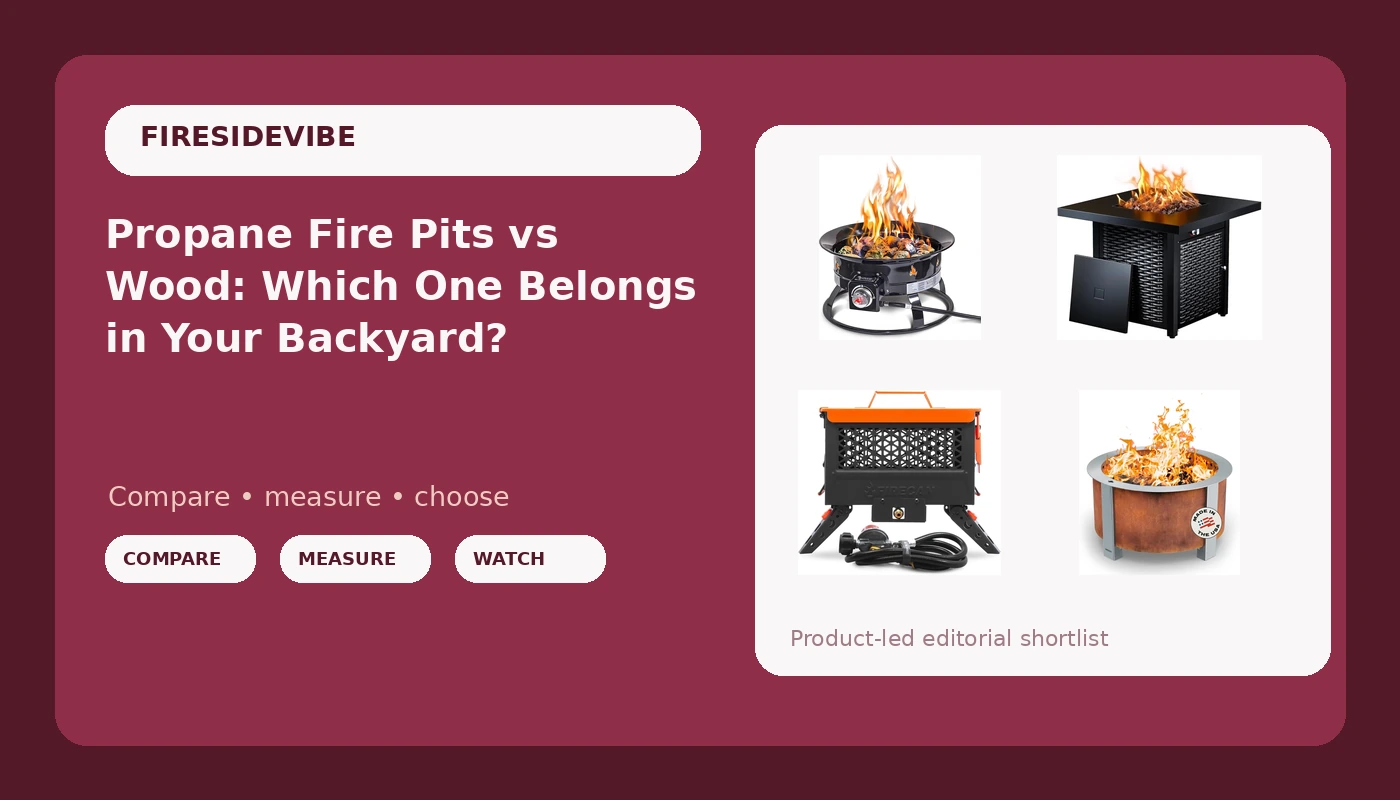
Choosing between propane fire pits and a wood-burning pit is less a question about hardware than about the evening you want to have. Gas gives you a flame in seconds, no ash to shovel, no smoke following you around the yard, and a shutoff valve when the last guest leaves. Wood gives you the crackle, the radiant heat you feel on your face, and the small ritual of feeding a fire as it burns down. Both are honest choices. The mistake is buying one while secretly wanting the other. This guide covers four fire pits that sit at different points on that map, three that run on propane and one that burns wood, and it walks through the details that decide whether you still like the thing in three years: fuel, size, steel, airflow, and what actually comes in the box.
Related: Smokeless Fire Pit Setup: Airflow, Fuel, and Placement →
Quick answer
Match the fuel to how you will use the pit, then match the size to the space. If you want instant on and off, no wood smoke, and no ash, propane is the simpler path, and the three gas options here differ mostly in form: a 19-inch portable bowl, a can-shaped packable pit, and a 28-inch table with a lid and lava rock. If the fire itself is the point, wood is the experience, and the Corten steel smokeless pit is the wood-burning option in this group. Buy gas for convenience and wood for ritual, and do not expect either one to do the other's job well.
Four useful options
| Model | Best fit | What stands out |
|---|---|---|
| Ciays 28 Inch Propane Fire Pit Table | A fixed patio or deck centerpiece | 50,000 BTU steel table, CSA-listed, includes lid and lava rock |
| Ignik FireCan Portable Propane Fire Pit | Packable camp setups and small spaces | Can-shaped portable pit with hose and regulator included |
| Outland Living Portable Propane Fire Pit | Camping, tailgating, and movable patio heat | 19-inch bowl, 58,000 BTU, cover and carry kit included |
| Breeo X Series 24 | A permanent backyard fire area with real wood | Corten steel, 27.5 inches, described as smokeless |
The patio centerpiece: Ciays 28 Inch Propane Fire Pit Table
A fire table earns its keep by being furniture when it is not a fire. The lid turns the bowl into usable surface area, which matters on a small patio where every square foot is already spoken for. Lava rock spreads the flame and covers the burner, and the CSA listing tells you the unit was evaluated against a recognized gas appliance standard, which is the kind of paperwork you want on anything connected to a propane tank. The trade-offs are real: this is a fixed piece that wants a level surface, a propane supply, and a cover for the off season. It will not throw the deep radiant heat of a log fire, and the flame is a burner flame, not a campfire. Buy it for evenings when you want light and warmth without hauling wood.
The packable one: Ignik FireCan Portable Propane Fire Pit
The FireCan is the smallest idea in this group: a personal-scale fire you can carry to a campsite, a tailgate, or a narrow city balcony. Because the hose and regulator are part of the package, you are not locked into a proprietary fuel cartridge, and you can feed it from a refillable tank instead. What you give up is scale. A pit this size warms the people sitting close to it, not a crowd, and it will not replace a full-size bowl or a table as the centerpiece of a patio. If most of your fires happen away from home, that is usually a trade worth making. If they happen in one spot in the backyard, it is not.
The portable workhorse: Outland Living Portable Propane Fire Pit
Two things make this one easy to live with: the cover and the carry kit come with it rather than as add-ons, and the bowl is small enough to move by hand. That combination is what makes a gas pit useful for camping, tailgating, and decks where you want the option of clearing the space afterward. The honest limitation is heat delivery. A gas flame in an open bowl mostly warms what it can see, so the people nearest the pit get the benefit. Sit a few feet back on a cold night and you will notice the difference between this and a wood fire. That is the convenience tax, and for a portable pit it is a fair one.
The wood-burning upgrade: Breeo X Series 24
This is the wood end of the list, and it behaves like wood. You need dry seasoned logs, you deal with ash, and you plan a permanent spot with clearance around it. What the design buys you is a better fire. Pits built around a secondary burn pull air and smoke back through the hot zone so less of it reaches your face, which is the difference between a fire people sit around and a fire people edge away from. Corten steel weathers to a stable rust patina instead of flaking apart, which is why it shows up in landscape work. The cost is upfront and the commitment is long. If you want a fire pit that outlives your patio furniture, this is the shape of that purchase.
Prices and availability may change. Product images, names, and retailer links must be matched by verified ASIN. Do not state a current price, rating, stock status, or measured result without current evidence.
How propane and wood fire pits actually differ
Wood burns as a radiant fire. You feel it on your skin because the flame and the coals beam heat outward, and the logs keep feeding it for hours if you keep feeding them. A gas pit works differently. The burner flame heats lava rock or ceramic media, and that media plus the flame warm the air and the surfaces nearby. You get fast, even, controllable heat at the pit, and less of that deep, pushy warmth that reaches the backs of the people sitting around a log fire.
Smoke is the second difference, and it is the one most people are actually shopping for. Wood smoke is unburned fuel, and it drifts toward whoever is downwind, which is often you. Smokeless wood designs reduce it by reburning the smoke inside the pit, but no wood fire is smoke-free in every wind and every fuel condition. Propane has no wood smoke at all, which is why it wins on a covered porch or anywhere the neighbors are close.
Then there is everything around the fire. Wood means ash, embers, a spark screen, and storage for dry logs. Propane means a tank, a hose, a regulator, and a shutoff valve. Wood fires are restricted or banned in some places during dry stretches; gas appliances are more often allowed to keep running, though that is a local call you should confirm before you buy. Start-up and cool-down differ too: gas is on and off in seconds, wood takes real time to establish and real time to die down safely.
What decides how long a fire pit lasts
Steel thickness is the whole argument. A thin, painted bowl looks fine in the showroom and rusts through after a season or two of rain and heat cycles. Heavier steel holds its shape, tolerates the thermal expansion of a hot fire, and can be refinished. Corten steel takes a different route: instead of fighting corrosion with paint, it forms a stable surface layer that protects the metal underneath, which is why it is common in landscape installations. Welds matter as much as gauge, since a pit is a container for something extremely hot and wet.
On gas pits, the burner assembly is the part that ages. Igniters, thermocouples, hoses, and regulators wear out before the steel does, so a pit with a serviceable burner and standard fittings is easier to keep running than one with proprietary parts. Accessories are not cosmetic either: a lid keeps rain out of the bowl, a cover keeps debris out of the burner, and a spark screen catches embers before they find your deck boards.
- Pick the fuel before you pick the model. Decide whether you are buying convenience or ritual, because everything else follows from that.
- Match the footprint to the space. A 19-inch bowl, a 28-inch table, a compact can, and a 27.5-inch wood pit occupy very different amounts of patio.
- Read what is in the box. Lid, lava rock, cover, carry kit, hose and regulator, and spark screen change the real cost of ownership.
- Check the two specs that matter most. Burner output for gas pits, steel thickness and weld quality for wood pits.
- Plan the off season. Know where the cover lives, where the tank is stored, and how the pit drains after rain.
Placement, safety, and the details people forget
- Give the pit clearance from anything combustible: deck rails, siding, furniture, and low branches overhead.
- Set it on a level, non-combustible surface, and never light a wood fire directly on a wood deck.
- Use a spark screen on any wood-burning pit, and keep a hose or extinguisher within reach.
- Store propane tanks upright and outside, and check hoses and regulators for cracking before the season starts.
- Burn dry, seasoned wood. Green wood smokes heavily and burns cool, which defeats the point of a smokeless design.
- Check local burn rules and any HOA restrictions before you buy, not after the first citation.
Which option should you choose?
Choose the Ciays 28 Inch Propane Fire Pit CSA-Listed Outdoor Fire Pit Table, 50,000 BTU Steel Gas Fire Pits with Lid and Lava Rock, Add Warmth and Ambience to Parties On Patio Deck Garden,Black,CIFPT3-N1 when you want a fixed patio centerpiece that closes into a table surface and runs on propane. Choose the Ignik FireCan Portable Propane Fire Pit with Hose and Regulator when your fires happen away from home and you need something that packs down and runs from an external tank. Choose the Outland Living Portable Propane Fire Pit, 19-inch, 58,000 BTU with Fire Pit Cover & Carry Kit, Smokeless Gas Firebowl | Perfect for Camping, Patio, Backyard, Tailgating, Deck, RV| Black 893 Deluxe when you want a portable bowl that arrives with its cover and carry kit. Choose the Breeo X Series 24 - Corten Steel Smokeless Fire Pit for Outside - 27.5 in when wood is the point and you have a permanent spot for a fire you tend by hand.
One caveat worth repeating: burner output is a specification, not a promise about how warm your patio will feel on a windy night, and included accessories can change between listings. Verify what is in the box on the current product page, and treat the manufacturer's manual and your local fire rules as the final word on safe use.
The bottom line
Fuel first, size second, steel third. If you want a flame you can switch on, sit beside, and switch off without ash or wood smoke, the three propane pits here cover the range from packable to permanent, and the fire table is the one that doubles as furniture. If you want the crackle, the radiant heat, and the ritual, the Corten steel wood pit is the choice that rewards the extra money and the extra work. Neither answer is wrong. The wrong answer is buying the convenient pit when you wanted the real one, or buying the real one and never lighting it because the cleanup is more than you bargained for.