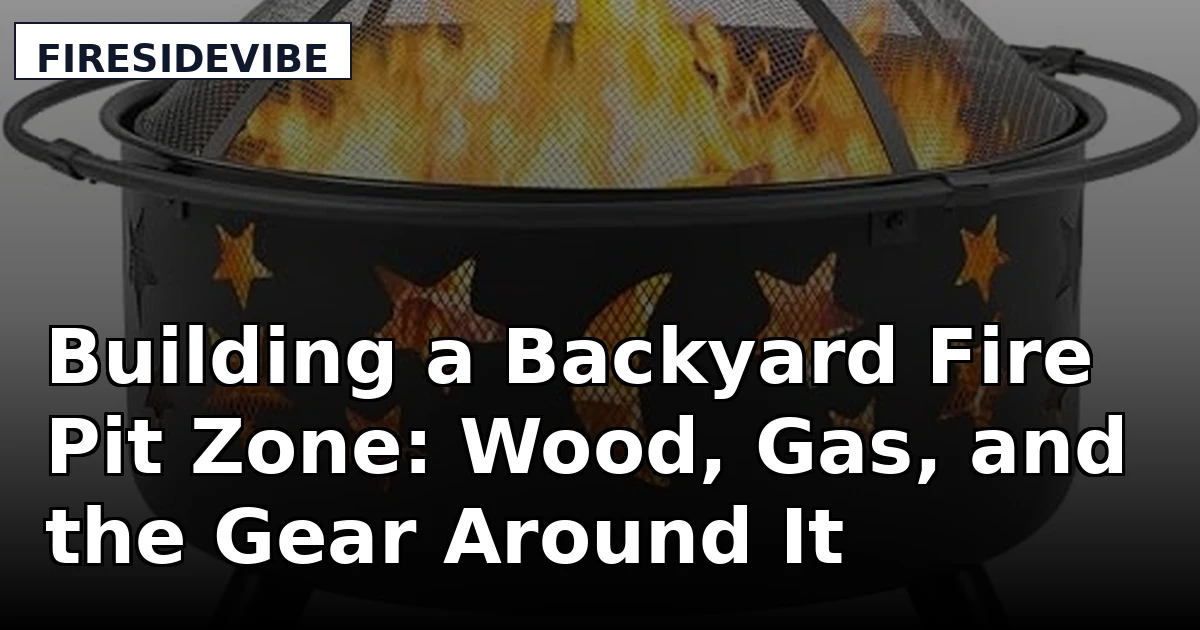
Most people buy a fire pit and then discover the pit was the easy part. A backyard fire pit setup is really three decisions stacked on top of each other: what you burn, what the thing sits on, and how people get to it after dark without tripping over a hose or stepping in mud. Get the fuel right and you will actually use the pit instead of looking at it. Get the base and the approach right and you will still be using it in five years instead of replacing it after one season. The four items below cover those jobs: a wood-burning bowl, a square propane fire pit table, reusable molds for casting your own path pavers, and a mat for the cabinet where all the small gear lives.
Related: Why Your Fire Pit Smokes You Out, and How to Fix the Airflow →
Quick answer
Decide fuel first, because it settles everything downstream. Wood gives you a real fire you have to feed, and it comes with smoke and ash. Propane gives you flame on demand with no ash, no embers, and no smoke in your jacket, but it is a gas appliance, not a campfire, and it should never be treated as one. Whichever you choose, set it on a level, non-combustible surface, keep it clear of anything that can burn, and give yourself a safe, lit walk to it. The picks below cover a 30-inch wood-burning pit, a square propane fire pit table, reusable concrete path molds, and a leak-guard mat for the gear cabinet.
4 useful options
| Model | Best fit | What stands out |
|---|---|---|
| Yaheetech 30in Fire Pits for Outside Wood Burning Outdoor Fireplace | Yards where the fire itself is the point | 30-inch wood-burning bowl with outdoor fireplace styling |
| Luxery Indoor Outdoor Square Propane Fire Pit Table with Lava Rocks | Patios that want flame without ash or smoke | Square steel table, propane fueled, lava rocks included, powder-coated black finish |
| Anothera 2Pack Walk Path Maker Reused Concrete Molds | Building a walkway or a level pad out of concrete | Two reusable 8-grid molds, each 15.7 by 15.7 by 1.57 inches |
| GORILLA GRIP LeakGuard Under Sink Mat | Containing drips from the small gear and supplies around the pit | 24 by 24 inch black mat with a leak-guard design |
Wood burning pick: Yaheetech 30in Fire Pits for Outside Wood Burning Outdoor Fireplace
Wood is the experience. You split it, you stack it, you watch it catch, and you poke it when it settles. That ritual is the reason people build fire pits in the first place, and a bowl like this one is where it happens. The trade-offs are honest ones. Smoke follows whoever sits downwind, ash has to go somewhere, and a wood pit puts embers in the air. Before you buy, check what the pit ships with and whether a spark screen or cover is part of the package, because those are the two accessories that decide how often you use it. Steel thickness matters more than any styling detail, and thin metal that holds water and ash is the thing that turns a pit into scrap. Put it on gravel, patio block, or bare mineral ground, never directly on a wood deck, and give it the clearance the manufacturer asks for.
The gas pick: Luxery Indoor Outdoor Square Propane Fire Pit Table with Lava Rocks
Gas is convenience, and pretending otherwise is how people end up disappointed. There is no campfire smell, no crackle, and no poking the logs, but there is also no smoke in your hair, no ash bucket, and no waiting forty minutes for the fire to be worth sitting next to. A table-style unit like this one also doubles as furniture, which matters on a small patio. The practical side is where a gas pit lives or dies. Propane has to be stored and refilled, the burner and lava rocks need to stay dry and clear of debris, and a cover is not optional if the table lives outside year round. As for indoor use, remember that any open flame consumes oxygen and produces carbon monoxide, so treat an indoor placement as something to confirm against the manufacturer's manual and your local code rather than something to assume from a product name.
The path builder: Anothera 2Pack Walk Path Maker Reused Concrete Molds
Concrete pavers are heavy, expensive, and a pain to haul, which is why molds like these make sense for a path that curves or a layout that does not fit a standard size. You mix, pour, tamp, cure, lift, and repeat. It is real work and the ground underneath still has to be leveled and compacted first, because a paver poured on soft dirt will tilt the first time it freezes. The payoff is a surface that stays put, drains reasonably, and gives you a defined walk from the patio to the fire. A cured paver also makes a stable, non-combustible surface for a wood-burning bowl to sit on, though you should still follow the pit's own clearance requirements and check local rules about open burning before you pour anything.
The gear protector: GORILLA GRIP LeakGuard Under Sink Mat
This is the odd one out in this lineup, and it earns its place for a boring reason: fire gear leaks. Lighter fluid tips. A propane canister sweats. Wet matches, a damp box of long sticks, a bottle of torch fuel, all of it sitting on a painted shelf or a wooden cabinet floor. A mat with a lip under it means the mess stays on the mat and the shelf stays intact. If your supplies live in a tote instead of a cabinet, the same logic applies, and a 24 by 24 inch mat covers a lot of the bottom. It is a few dollars of prevention standing between you and a rust ring you will look at for a decade.
Prices and availability change, and listings get updated. Check current Amazon price on the product page before you buy, and confirm what is included in the box.
How airflow decides whether your fire smokes you out
A wood fire needs three things: fuel, air, and heat. Smoke is unburned fuel, which means a smoky fire is a fire that is not getting enough air or is not hot enough to burn what it releases. That is the entire mystery. If you want to sit by a fire without crying, you are really managing airflow.
Open bowls work by giving hot gases room to rise while fresh air feeds the base of the fire. Stack wood loosely with gaps between the pieces instead of packing it tight. Air has to move through the fuel, not around it. Start with small dry wood and build up rather than dumping a pile of big splits on a match. Seasoned wood makes a difference too: wet wood spends its heat boiling off moisture instead of burning clean, and that is where a lot of white smoke comes from.
Smokeless designs take this further with a double wall that pulls air down and feeds it back into the top of the burn, where it ignites the smoke a second time. That secondary burn is real, and it works, but it is a design feature and not a magic trick. Wind still moves smoke around, and a fire that has not reached temperature will still be smoky. The honest test for any pit is the same one I use: sit downwind for an evening and see what your clothes smell like in the morning.
Steel, bases, and what actually survives a season
Steel thickness is the number nobody puts on the box and the one that decides whether you get a decade or a single season. Thin sheet metal warps under heat, dents when you bump it with a log, and rusts through wherever ash and rain collect. Thicker steel holds its shape and its finish. If a listing will not tell you the gauge, treat that as information in itself.
The finish matters almost as much. Powder coating holds up better than paint, but every chip is a place for moisture to start working. Ash is the quiet enemy here: it holds water against the metal long after the rain stops. Empty the ash after a burn once everything is cold, keep a cover on the pit, and you have solved most of the rust problem before it starts.
The base is the other half of the equation. A fire pit needs a level, non-combustible surface: gravel, patio block, a cured concrete paver, bare mineral soil. Wood decks, dry grass, mulch, and composite decking are all things you should keep a fire away from, and that includes the heat radiating off a gas table. Check the clearance the manufacturer specifies and treat it as a minimum. And use a spark screen. I have seen what one ember does to a deck, and it is not a repair you want to pay for.
- Pick your fuel: wood if the fire itself is the point, propane if you want flame on demand without ash.
- Measure the spot and check the manufacturer's clearances and your local rules before you set anything down.
- Build the base: level, non-combustible, and clear of anything that can burn.
- Fix the approach with a path or stepping stones so nobody crosses mud or trips in the dark.
- Sort out storage: a cover, an ash container, a safe spot for the propane tank, and a mat under the small gear.
Setting up the zone in a weekend
- Choose a spot at least the manufacturer's stated distance from the house, fence, and any low branches, and check local burn rules first.
- Level the ground before anything else. A pit on a slope will lean, and a paver on soft dirt will tilt.
- Keep seating out of the prevailing wind path so the smoke has somewhere to go that is not your guests.
- Decide where the ash and the propane live before the first burn, not the morning after.
- Buy a cover the same week you buy the pit. Covers are cheap, and rust is not.
Which option should you choose?
Choose the Yaheetech 30in Fire Pits for Outside Wood Burning Outdoor Fireplace when you want a real wood fire and you are willing to deal with smoke, ash, and feeding it. Choose the Luxery Indoor Outdoor Square Propane Fire Pit Table with Lava Rocks when you want a flame you can switch on, no cleanup, and a surface that doubles as a patio table. Choose the Anothera 2Pack Walk Path Maker Reused Concrete Molds when the walk out to the fire is mud half the year and you would rather cast pavers than buy and haul them. Choose the GORILLA GRIP LeakGuard Under Sink Mat when your fire-starting supplies live in a cabinet or a tote and you would like the shelf underneath to survive them.
A caveat worth stating plainly: none of this replaces the manual that comes with your pit. Clearances, fuel types, and cover requirements vary by model, and no product name tells you the steel gauge or what is in the box. Confirm those details on the listing and in the paperwork before your first burn, and check local rules about open burning where you live.
The bottom line
A fire pit is not a purchase so much as the center of a small system: the fire itself, the surface it sits on, the path that leads to it, and the corner where the gear lives. Get the fuel decision right and the rest is straightforward. Wood gives you the real thing with real smoke. Propane gives you a flame without the cleanup. A cast paver path keeps you out of the mud, and a mat keeps the cabinet from becoming a chemical spill. Pick the fire you will actually light on a Tuesday night, build it a safe base, and the rest of the yard tends to sort itself out.