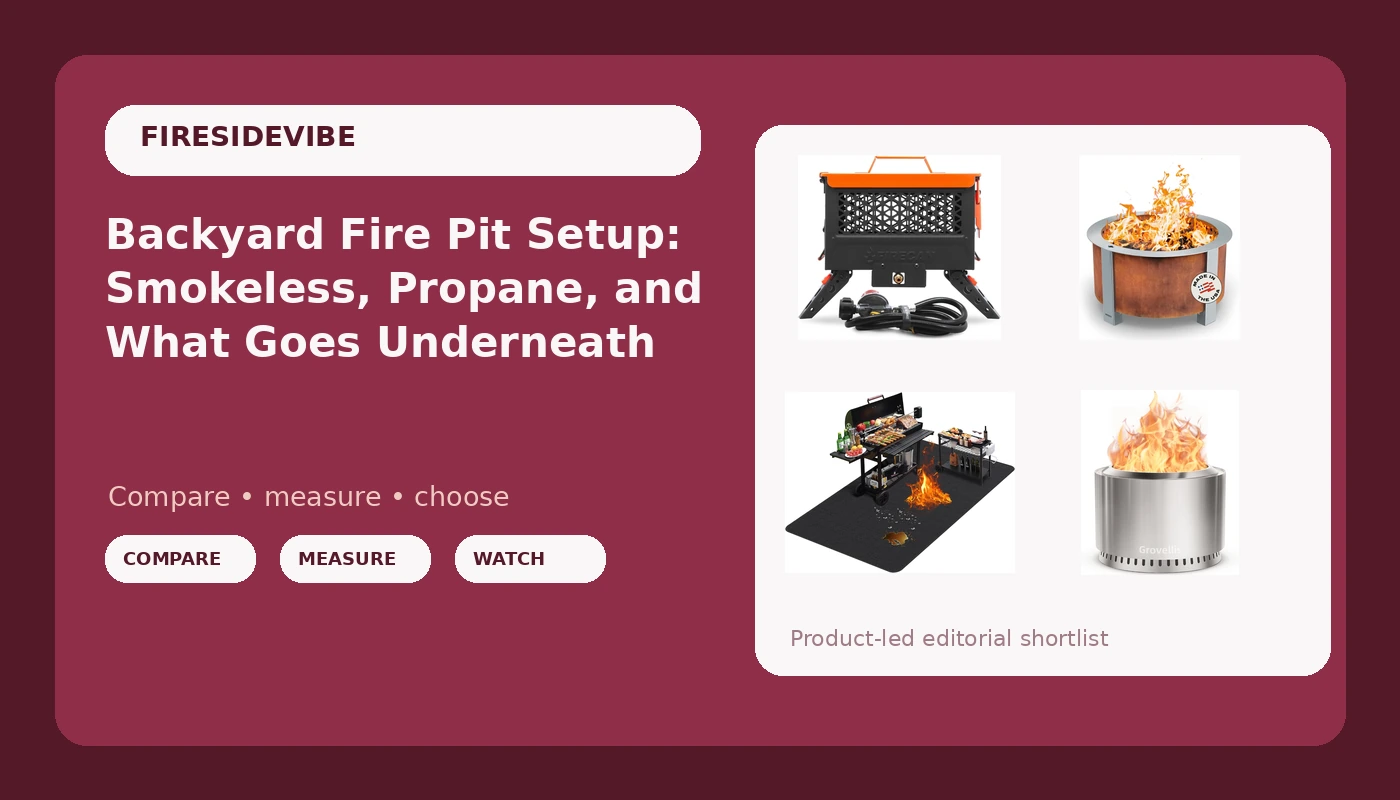
A backyard fire pit setup is really three purchases pretending to be one: the fire itself, the thing that holds it, and the surface that survives it. Most people get the first two roughly right and then wonder why their deck has a scorch ring, or why the smoke follows whoever is sitting downwind no matter how many times the chairs get rearranged. Smoke management, steel thickness, and surface protection are the three variables that decide whether a fire pit becomes a nightly habit or a decoration you quietly stop lighting by August. The four products below cover those variables from different angles: two wood-burning smokeless pits at opposite ends of the price range, one propane option for people who want flame without ash, and one mat that keeps the whole thing from ruining the patio underneath. This is a backyard fire pit setup explained by what each piece actually does, not by which one photographs best.
Related: Fire Pit Placement: Where a Fire Pit Should Actually Sit →
Quick answer
If you burn wood and want a pit you will still own in ten years, the Breeo X Series 24 is the Corten steel option in this group. The 27 inch Smokeless Fire Pit with Waterproof Cover & Fire Poker is the turnkey alternative that arrives with the accessories most people end up buying separately. If you want flame without wood, ash, or spark chasing, the Ignik FireCan Portable Propane Fire Pit with Hose and Regulator runs on propane. Whichever direction you go, the TAOMAND Large 76 x 52 inches Under Grill Mats is worth putting down first if the pit sits on a deck, patio, or driveway you would rather not stain.
Four useful options
| Model | Best fit | What stands out |
|---|---|---|
| Breeo X Series 24 - Corten Steel Smokeless Fire Pit for Outside - 27.5 in | A permanent backyard build you keep for years | Corten steel body, 27.5 inch size, smokeless design |
| 27 inch Smokeless Fire Pit with Waterproof Cover & Fire Poker | A first smokeless pit that arrives complete | Waterproof cover and fire poker included, 27 inch footprint |
| Ignik FireCan Portable Propane Fire Pit with Hose and Regulator | Decks, patios, and places where wood is a hassle | Propane fueled, portable form, hose and regulator included |
| TAOMAND Large 76 x 52 inches Under Grill Mats for Outdoor Grill | BBQ Mat | Any setup that sits on a surface you want to protect | 76 by 52 inch coverage for drips, grease, and debris |
The long-term build: Breeo X Series 24 - Corten Steel Smokeless Fire Pit for Outside - 27.5 in
Corten steel is the reason this one sits at the top of the range. It is not coated, so there is no finish to blister off after two summers, and the rust-colored patina it develops is the material doing its job rather than failing. The trade-offs are the ones that come with any premium pit: it is heavy, it wants a level and non-combustible base, and it will outlast the patio furniture around it. Corten also stains porous surfaces if it sits directly on them, which is exactly why the mat further down this page earns its place. If you are building a fire pit area once and want to stop thinking about it, this is the category that makes sense.
The turnkey kit: 27 inch Smokeless Fire Pit with Waterproof Cover & Fire Poker
The cover is the part that matters here. A fire pit does not die from burning, it dies from sitting wet from October to April, and a fitted waterproof cover is the cheapest insurance in this entire category. A poker sounds like a throw-in until you have tried moving a half-burnt log with a stick you found in the yard. What this listing does not tell you is the steel gauge, and that is the number that decides whether you get a decade or a season. Ask the seller, or read the questions on the listing before you commit, because a smokeless design on thin steel is still thin steel.
The propane option: Ignik FireCan Portable Propane Fire Pit with Hose and Regulator
Gas is convenience, and it is worth saying plainly that it is not a campfire. You get an instant flame, a shutoff valve, no smoke in your hair, and no ash to shovel the next morning. You give up the smell, the crackle, and the small ritual of feeding logs. The other practical advantage is regulatory: when a county or a park puts a burn ban in place, propane appliances are often still allowed, which is why a portable unit like this stays useful in a dry mountain autumn. It also travels, which a Corten steel pit does not. If your fire pit night is really a hosting night, this is the version that starts in thirty seconds and ends when the last guest leaves.
The surface protector: TAOMAND Large 76 x 52 inches Under Grill Mats for Outdoor Grill | BBQ Mat
Be clear about what a mat does and does not do. It handles grease, ash dust, dropped food, and the general mess that a fire or a grill produces, which is the difference between a patio that wipes clean and a patio with a permanent dark ring. It is not a substitute for a non-combustible base under an open fire. A fire pit still needs to sit on stone, brick, gravel, or a rated pad, with the mat underneath catching the mess rather than providing the heat barrier. Sizing is the other thing to check: 76 by 52 inches is large, which is good for a seating circle, but measure your space before ordering because a mat that curls up at the edges catches a rake and never lies flat again.
Prices and availability may change. Product images, names, and retailer links are matched to verified listings. No current price, rating, stock status, or measured result is stated here without current evidence.
How smokeless fire pits actually work
A conventional fire pit burns wood in one stage. The logs release gases as they heat, those gases rise, and if the pit is not hot enough or the airflow is wrong, they leave as visible smoke. That is the smoke that finds you no matter where you sit, because it is warm and rising and then cooling and falling, and you are in the way.
A smokeless pit adds a second stage. Double-wall construction pulls outside air up between the walls, preheats it, and feeds it back into the top of the firebox through a ring of holes. That superheated oxygen meets the unburned gases above the logs and ignites them. This is what people mean by secondary burn: the smoke is fuel, and the pit is designed to burn it before it leaves.
The result is less smoke, not zero smoke. Cold starts smoke. Wet wood smokes. Overloading the firebox smokes. A smokeless pit at temperature with dry, split hardwood is a genuinely different experience from a $60 bowl with holes punched in the side, but the technology is a design, not a magic trick. If you want the honest version: buy the smokeless design, then feed it dry wood and let it come up to temperature before you judge it.
Steel gauge, Corten steel, and the season test
The single number that predicts how long a fire pit lasts is the thickness of the steel. Very thin bodies, the kind found in the cheapest pits on the market, burn through or rust through quickly because there is no material left once corrosion starts. Thicker steel holds heat better, warps less under thermal cycling, and gives you something to weld if a leg ever fails. When a listing will not tell you the gauge, that silence is information.
Corten, or weathering steel, behaves differently from painted steel. It is formulated so the surface rust stabilizes into a dense, protective layer instead of continuing to eat inward. That is why it is used in outdoor sculpture and landscape edging. Painted mild steel, by contrast, is only as good as the paint, and the paint always loses to a fire.
Then there is the weather test. A pit left uncovered through a wet winter is the most common way a decent product becomes a rusted one. A waterproof cover, a dry storage spot, or both, is the difference between a pit you still like in year five and a pit you replace in year two.
Before you buy, run the decision in this order:
- Choose the fuel. Wood if you want the real thing, propane if you want convenience and a shutoff valve.
- Decide permanence versus portability. A heavy steel pit stays where you put it, and a portable one travels.
- Find the steel gauge, or at least confirm the material and thickness. Corten and thick mild steel last, thin painted steel does not.
- Check what is included. A cover, a poker, and a spark screen are not extras, they are the difference between a fire night and a repair bill.
- Plan the surface. Non-combustible base, clearance from anything that can burn, and a mat or pad to catch the mess.
Setting it up so the smoke stays out of your face
- Site the pit with at least ten feet of clearance from structures, low branches, and anything with a roof over it, and check local rules before the first burn.
- Put a non-combustible base under the pit and extend it past the footprint, since embers land outside the bowl.
- Keep a spark screen on hand. Embers and wood decks are a combination that ends with a contractor.
- Burn dry, split hardwood. Wet or green wood defeats a smokeless design faster than any other variable.
- Cover the pit or move it under shelter when the season ends, because water, not fire, is what kills most fire pits.
Which option should you choose?
Choose the Breeo X Series 24 - Corten Steel Smokeless Fire Pit for Outside - 27.5 in when you are building a permanent fire area and want Corten steel that develops a patina instead of peeling. Choose the 27 inch Smokeless Fire Pit with Waterproof Cover & Fire Poker when you want a smokeless wood pit that arrives with the cover and poker already in the box. Choose the Ignik FireCan Portable Propane Fire Pit with Hose and Regulator when you want flame on demand, no ash, and a unit you can move. Choose the TAOMAND Large 76 x 52 inches Under Grill Mats for Outdoor Grill | BBQ Mat when the pit or grill sits on a surface you intend to keep clean, remembering that it protects against mess and not against heat.
One caveat that applies to all four: this article describes what the listings state and what the designs are built to do. It does not report burn tests, heat output measurements, or long-term durability results, and no current price, rating, or stock status is quoted here. Verify the specifications on the listing before you buy.
The bottom line
A backyard fire pit setup works when the three decisions line up: fuel, steel, and surface. Wood gives you the experience, propane gives you the convenience, and the steel gauge decides whether you are buying a fire pit or renting one for a season. Pick the smokeless wood pit that matches your budget and commitment, add propane only if convenience is the actual goal, and put something under the whole thing so the patio survives the hobby. Then buy dry wood, keep the cover on when it rains, and let the fire come up to temperature before you decide whether the smokeless claim holds up in your own yard.