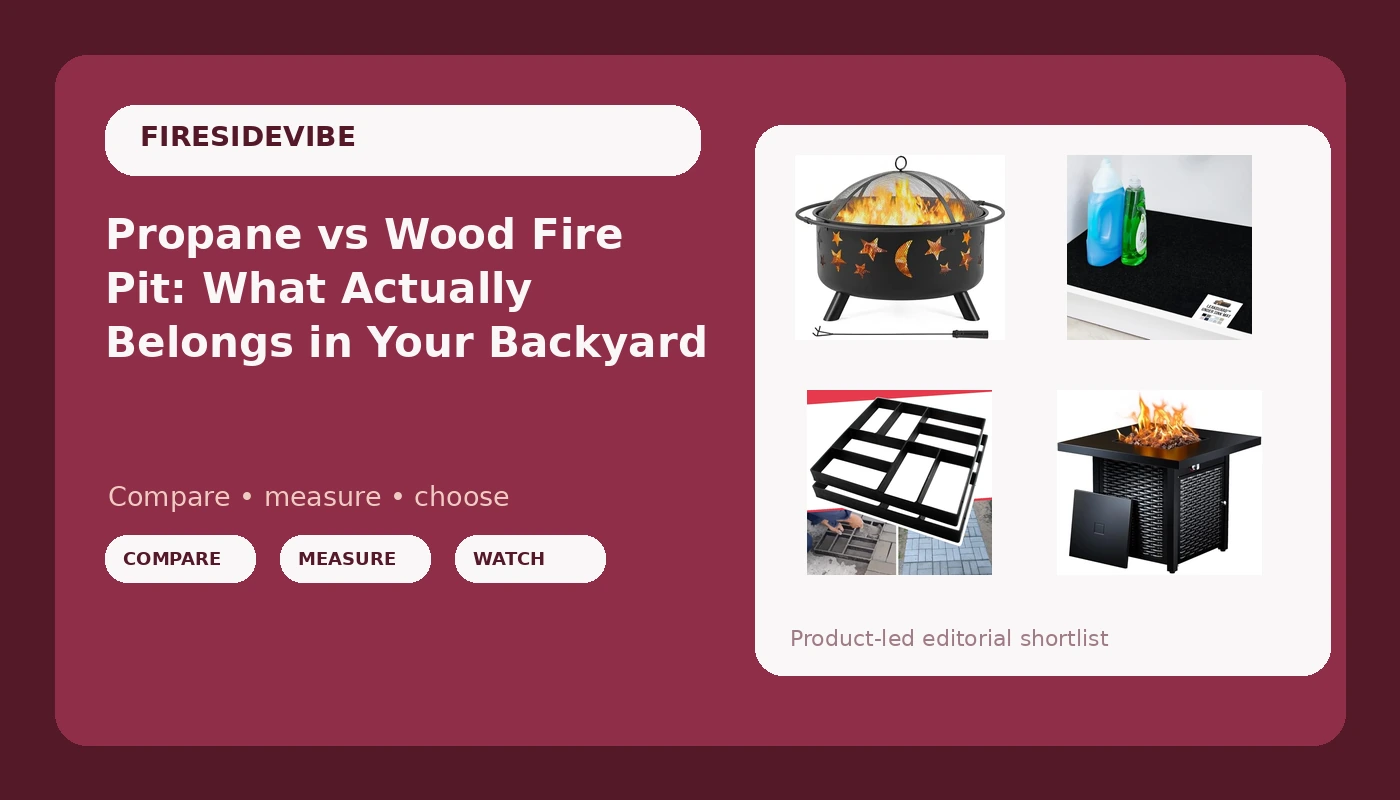
A fire pit is not one product. The propane vs wood fire pit question is really a question about which version of the evening you are buying. Wood gives you the smell, the crackle, and the ritual of building something and watching it collapse into ash. Propane gives you a switch, a flame, and nothing to shovel the next morning. Neither choice is a compromise when you make it on purpose. The mistakes start when someone buys the wrong fuel for their habits, or when every dollar goes into the pit itself and nothing goes into the ground beneath it, the cabinet where the supplies live, or the path guests walk in the dark. That whole zone is what you are actually building.
Related: How to Break In a New Fire Pit Without Smoking Out the Patio →
Quick answer
If you want flame on a whim with no wood, no ash, and no smoke in your hair, the Ciays 28 Inch Propane Fire Pit Table is built for exactly that evening. If you want the real thing, the Yaheetech 30in wood-burning outdoor fireplace is a straightforward steel pit that takes actual logs. Two supporting pieces finish the zone: a waterproof mat for the cabinet where your fire supplies and damp gloves end up, and a reusable paver mold if the walk to the pit is still dirt. Match the fuel to your habits first, then spend what is left on the ground and the storage around it.
Four pieces of a working fire pit zone
| Model | Best fit | What stands out |
|---|---|---|
| Ciays 28 Inch Propane Fire Pit CSA-Listed Outdoor Fire Pit Table, 50,000 BTU Steel Gas Fire Pits with Lid and Lava Rock, Add Warmth and Ambience to Parties On Patio Deck Garden,Black,CIFPT3-N1 | Evenings when you want fire without tending wood | Propane table design, CSA-listed, 50,000 BTU rating, ships with a lid and lava rock |
| Yaheetech 30in Fire Pits for Outside Wood Burning Outdoor Fireplace | Backyards that want real logs and real smoke | 30-inch wood-burning outdoor fireplace, no tank or fuel line involved |
| GORILLA GRIP LeakGuard Under Sink Mat for Kitchen Cabinet, 24x24 Black | Keeping the cabinet where your supplies live dry | 24x24 inch mat with a leak-guard design for the cabinet floor |
| Anothera 2Pack 15.7"x15.7"x1.57" Walk Path Maker Reused Concrete Molds Pathmate Stone Molding Stepping Stone Paver Walk Way DIY Path Paving Garden Yard Patio Mold (8-Grid) | Building a solid walk to the fire | Two reusable 8-grid concrete molds for pouring your own stepping stones |
The gas option: Ciays 28 Inch Propane Fire Pit
Here is the honest trade. A propane table gives you heat and ambience without a single split log, and the lid means the unit earns its footprint on the patio all week, not just on Saturday night. What you give up is the part most people actually remember: the smell, the smoke drifting when the wind shifts, the way a fire changes character over three hours. You also take on a fuel supply. A propane tank is one more thing to check, refill, and store upright, and it is one more reason the pit has to live somewhere with room for the tank and safe clearance around it. Buy this one because you want convenience and you are willing to say so out loud.
The wood option: Yaheetech 30in Fire Pits for Outside Wood Burning Outdoor Fireplace
Wood is the experience. It is also work: sourcing dry fuel, managing the burn, and dealing with ash that has to go somewhere that is not your lawn. What wood gives back is heat quality. A wood fire throws radiant heat that you feel on your face from several feet away, and it keeps producing that heat as long as you keep feeding it, with no tank to run dry mid-guest. The catch with any wood pit is steel and weather. A pit left out through a wet season, full of ash and water, is a pit that will not look new in year two. Cover it, empty it, and it will outlast your patio furniture.
The storage protection: GORILLA GRIP LeakGuard Under Sink Mat
This one is not a fire pit, and pretending otherwise would be silly. It is here because a fire pit zone has a supply problem. Lighters, matches, fire starters, a wire brush, gloves that got rained on, and a tarp that went out wet all end up in the same cabinet or utility shelf, and that shelf is usually the one under a sink or beside a water heater. A mat like this keeps the drip contained instead of letting it soak into particle board, which swells once and never closes again. It is a cheap way to protect the storage that makes the rest of the setup usable.
The path builder: Anothera Walk Path Maker Concrete Molds
Most backyard fire pit projects fail at the ground, not at the fire. Guests arrive after dark, the grass is wet, and the route from the deck to the seating circle turns into a mud track that gets tracked back inside. Pouring your own pavers solves that for the cost of a bag of concrete and an afternoon. The work is real: you mix, you fill, you level, you wait for cure, then you lift the mold and repeat down the line. Do it on a dry day and keep the stones level with the surrounding turf so nobody catches a toe. It is the least exciting purchase in this article and the one people notice every single time they walk out with their hands full.
Prices and availability can change between reading and buying. Confirm the details, dimensions, and included accessories on the listing before you order.
Steel gauge is the number nobody advertises
Ask most shoppers what they compared and they will quote BTU or diameter. The number that decides whether a pit is still standing in five years is steel thickness, and it is usually the hardest spec to find. Thin steel heats fast, cools fast, and warps. It also rusts from the inside out once ash and rainwater sit in the bowl, because ash is alkaline and holds moisture against the metal. Thicker steel holds heat longer, resists warping, and gives you something to weld or repaint if the finish fails.
You do not need a lab to judge this. Weight is the proxy. If a 30-inch pit feels light enough to carry under one arm with ease, the steel is thin and you should treat the purchase as a temporary one. That is a legitimate choice at a low price point, as long as you buy it knowing that. What is not legitimate is paying premium money for a pit that weighs the same as the cheap one.
Smoke is an airflow problem, not a fuel problem
People blame wood for smoke. Wood is the fuel; airflow is the cause. A fire smokes when it cannot pull enough oxygen into the base of the burn, so the volatiles rise unburned and condense into the visible plume that follows whoever moves. Wind direction only decides who receives it.
That is why smokeless designs exist: they add a second combustion zone that burns the smoke before it leaves the pit, which requires double-wall construction and a lot of engineering. The pits in this article are not making that claim, and that is fine. What you can control is placement and fuel. Dry, split, seasoned wood smokes far less than damp rounds. A pit set in an open spot with clearance on all sides drafts better than one tucked against a fence. And a pit loaded to the brim with logs chokes itself, because there is no room for air to move between them.
Five steps to make the call:
- Decide which evening you actually host most often: a two-minute flame or a three-hour burn.
- Confirm the fuel supply you are willing to manage, including tank storage or a dry woodpile.
- Check the construction for real steel weight and a spark screen or lid that covers the opening.
- Measure the space, including clearance from siding, railings, and anything that can catch an ember.
- Budget for the ground and the storage, not just the pit itself.
Setting up the zone safely
- Keep the pit on a non-combustible surface such as stone, gravel, or concrete, never directly on a wood deck or dry grass.
- Maintain clearance from walls, fences, and low branches, and check your local burn rules before the first fire.
- Use a spark screen or the supplied lid whenever the fire is burning, because embers travel farther than people expect.
- Store fuel and supplies somewhere dry and contained, and never leave a wet tarp or soaked gloves sitting on a cabinet floor.
- Let ash cool completely before you empty it, and put it in a metal container, not a paper bag or a plastic bin.
Which option should you choose?
Choose the Ciays 28 Inch Propane Fire Pit when you want a flame on demand, you are hosting on a schedule, or smoke is a genuine problem for you or your neighbors. Choose the Yaheetech 30in Fire Pits for Outside Wood Burning Outdoor Fireplace when the ritual matters more than the convenience and you have a place to keep dry wood. Choose the GORILLA GRIP LeakGuard Under Sink Mat when you need to protect the cabinet or shelf where your fire supplies live. Choose the Anothera Walk Path Maker Concrete Molds when the walk to the pit is still dirt and you want to fix that before the next gathering.
One caveat worth stating plainly: fuel choice and build quality are separate questions. A propane table and a wood pit can both be well made or poorly made, and price alone does not tell you which. Read the construction details, look at the weight and dimensions, and confirm what is actually in the box, because lids, screens, and covers are frequently the first things dropped to hit a price point.
The bottom line
Build the zone, not just the fire. Start with the fuel decision, because it determines everything downstream: whether you need a tank, whether you need a woodpile, how much tending you signed up for, and how long the evening lasts. Then spend the remaining attention on the parts nobody photographs. A pit sitting on bare dirt with a muddy walk to it and a cabinet full of damp gear is a project half finished, no matter how good the fire looks. Get the fuel right, get the ground right, and the backyard stops being a chore and starts being the room you actually use.