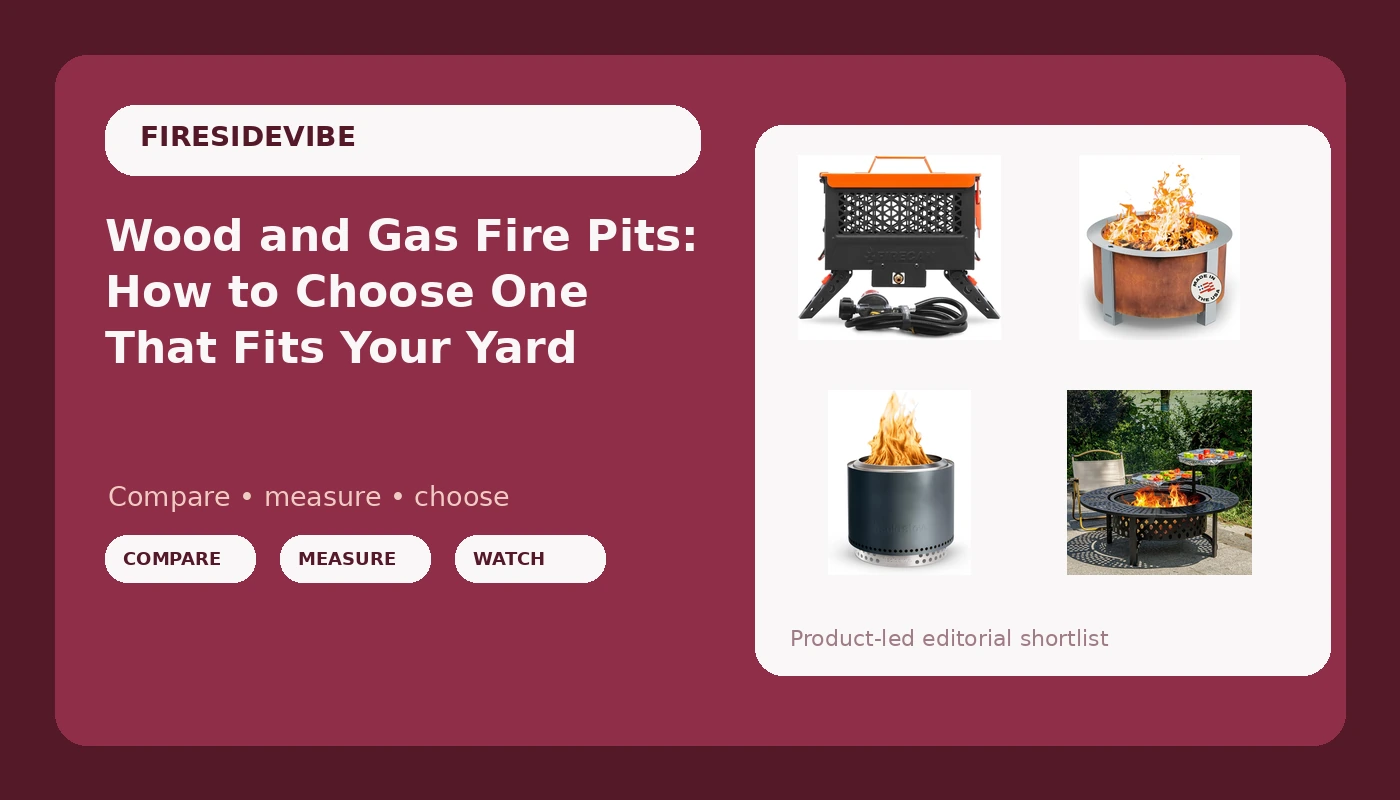
Most people shopping for wood and gas fire pits start with the wrong question. They ask which one looks best on the patio, which one the neighbor has, or which one happens to be discounted this weekend. The question that actually decides whether you light the thing twice a year or fifty times is narrower: where does the smoke go, and what are you willing to feed it?
A fire pit that smokes you out of your own seating area is a fireplace with a seating problem. That one failure mode sends more pits to the curb than rust, size, or price ever will. The second decision is fuel, and it splits cleanly. Wood is the experience: real flame, real smell, real ash to shovel the next morning. Gas is the convenience: instant flame, no embers, no hauling logs across the yard. Neither is superior, but they lead to completely different products, and confusing the two is how people end up disappointed by a purchase that looked perfect in a photo.
This is an explainer rather than a ranking. It walks through four very different fire pits, what actually separates them, and how to tell which category you belong in before you spend anything.
Related: Smokeless Fire Pit First Burn: Airflow, Fuel, and Setup →
Quick answer
Settle the fuel first and the footprint second. For a fixed backyard spot with a wood fire and less smoke, a smokeless design such as the Solo Stove Bonfire w/Stand or the Breeo X Series 24 is the category to shop. For flame without wood, ash, or drifting embers, a portable propane pit such as the Ignik FireCan Portable Propane Fire Pit with Hose and Regulator is the simpler route. For the widest basin and included cooking grills, the OutVue 47 Inch Fire Pit with 2 Grills covers that. Everything else, finish, accessories, and style, is a detail you can settle once the fuel question is closed.
Four useful options
| Model | Best fit | What stands out |
|---|---|---|
| Solo Stove Bonfire w/Stand | Backyard family nights on wood | 19.5 inch smokeless wood burner with an included stand |
| Breeo X Series 24 | A permanent backyard centerpiece | Corten steel construction, 27.5 inch smokeless design |
| Ignik FireCan Portable Propane Fire Pit with Hose and Regulator | Camping, patios, and no-wood settings | Propane fuel with hose and regulator included |
| OutVue 47 Inch Fire Pit with 2 Grills | Cooking and large-group evenings | 47 inch basin with two included grills |
The smokeless wood standard: Solo Stove Bonfire w/Stand | 19.5" Smokeless Wood Fire Pit, Gunmetal
The trade-off with any pit in this shape is heat. A 19.5 inch bowl holds a modest load of wood, and the smokeless design moves most of the burn sideways and up rather than blasting warmth at your knees. It is a sit-close fire, the kind you circle with four or five people and a blanket. The stand matters more than it sounds: bare metal bases get hot enough to mark a deck, and lifting the pit off the surface is the difference between a fire night and a repair estimate. As with any wood pit, you need dry, seasoned fuel and a metal container to haul ash. Feed it wet wood and no amount of engineering will save the experience.
The permanent build: Breeo X Series 24 - Corten Steel Smokeless Fire Pit for Outside - 27.5 in
Corten steel is the reason this one is worth explaining. Ordinary painted steel rusts from the inside out once moisture gets under the coating, and that is what kills cheap pits in a season or two. Corten is formulated so the surface rust layer seals and then stops progressing, which is why you see it on landscape walls and outdoor sculpture. The look changes: it starts orange-brown and darkens with weather. If you want a pit that stays factory-fresh looking, this is the wrong material. If you want one that can stay in the yard through winter without being covered, it is the right one. The catch is placement. A 27.5 inch pit at this build level is a landscape decision, not an impulse buy, and it is not something you carry to a campsite.
The propane route: Ignik FireCan Portable Propane Fire Pit with Hose and Regulator
Here is the honest framing: a propane pit is a convenience purchase, and the convenience is real. You turn a valve, you get flame, you turn it off, and the evening ends without a single ember floating toward a dry lawn. There is no ash to dump, no logs to source, and no smoke in your hair or your neighbor's window. What you give up is the part that makes a wood fire worth sitting around: the smell, the crackle, the slow build of coals. The included hose and regulator matter because it means the pit runs off a refillable tank instead of disposable canisters, which changes the cost of a long evening considerably. Before you use any open flame, check local burn rules, because propane and wood are often treated differently during dry stretches.
The wide basin with grills: OutVue 47 Inch Fire Pit with 2 Grills
A 47 inch pit is a different animal from a 19.5 inch bowl. It needs a real footprint, it burns more fuel per evening, and it throws heat across a wider circle, which is exactly what you want for a crowd. The two grills are the practical addition: they let you move a pot or a grate over live coals without dragging a separate cooking setup outside. The trade-off is that wide open pits move more smoke than a double-wall smokeless design, so seating position matters more, and you should expect to manage the fire rather than just enjoy it. It is also not a pit you relocate on a whim.
Prices and availability may change. Product images, names, and retailer links are matched to verified listings. No current price, rating, stock status, or measured result is stated here without current evidence.
How a smokeless fire pit actually works
Smoke is unburned fuel. When wood burns, the gases released ahead of the flame carry particles that only combust at higher temperatures. In an open bowl, those gases cool before they can burn, which is why you get a column of smoke and a fire that chases you around the circle as the wind shifts.
A smokeless design changes the airflow rather than the wood. The burn chamber is surrounded by a second wall, and preheated air is drawn through it and injected above the fire. That air feeds a secondary burn, igniting the gases that would otherwise leave as smoke. The result is a hotter, cleaner burn with far less visible exhaust, and more of the fuel converted to heat instead of particulate.
Two things follow from that. First, smokeless does not mean flameless or effortless: the pit still needs dry fuel and enough airflow to reach temperature, and a cold, smothered fire smokes no matter what shape the bowl is. Second, a smokeless pit is not a heater in the way people expect. Much of the heat rises with the flame rather than radiating outward, so you sit closer, and you judge it by whether your eyes sting, not by whether your shins are warm.
What decides whether a fire pit lasts
Steel thickness and material decide the lifespan more than any other spec. Thin sheet metal heats and cools through every burn, and that cycling plus trapped moisture is what produces rust-through. Thicker steel and weathering alloys tolerate that cycle for far longer, which is why a heavy pit that looks plain often outlives a decorative one that looks expensive.
Beyond the metal, three things matter: whether the base is lifted off the surface, whether there is a real spark screen or mesh cover for embers, and whether the pit can drain water instead of holding it. A pit that collects rainwater in the bowl and never dries out is being tested every day it sits outside.
Here is the order worth working through before you buy:
- Pick the fuel. Wood if you want the full experience and will manage ash; propane if you want flame on demand with no cleanup.
- Measure the space, including clearance. A wide pit needs a wider circle of non-combustible surface and more distance from railings, siding, and low branches.
- Decide whether it stays or travels. A permanent centerpiece can be heavy and weathered; a portable pit has to be light enough to actually load.
- Check the steel and the base. Thicker material and a lifted base outlast thin metal sitting flat on a deck.
- Confirm the safety pieces. A spark screen, a stable base, and a plan for where ash or a propane tank lives are not optional extras.
Practical guidance for the first season
- Burn dry, seasoned wood. Green or damp wood produces the smoke that a smokeless design is working to eliminate.
- Start with a small, hot fire and add to it. Smoldering loads smoke regardless of the pit.
- Keep the pit on a non-combustible surface and respect the clearance to walls, furniture, and overhangs.
- Use a spark screen or mesh cover, especially on a deck, and keep a bucket of water or a hose within reach.
- Cover or invert the pit when it is not in use, or place it where water drains instead of pooling in the bowl.
- Empty ash only when it is fully cold, and put it in a metal container, never a paper bag or plastic bin.
Which option should you choose?
Choose the Solo Stove Bonfire w/Stand when you want a wood fire in a fixed backyard spot, you care most about keeping smoke out of the seating circle, and you want the included stand so a deck or patio is protected. Choose the Breeo X Series 24 when the pit is going to live outside year-round as part of the landscape and you want Corten steel rather than painted metal. Choose the Ignik FireCan Portable Propane Fire Pit with Hose and Regulator when you want flame without wood, ash, or embers, or when you need something that packs for a campsite. Choose the OutVue 47 Inch Fire Pit with 2 Grills when you have the space for a wide basin and you want to cook over the fire.
One caveat applies to all four. Nothing here is a substitute for reading the current listing, checking the dimensions against your actual space, and following the manufacturer's clearance and safety instructions. Specifications and available finishes can change between batches, and the only way to confirm what you are buying today is to look at the listing itself.
The bottom line
The fire pit decision is mostly a fuel decision, and the fuel decision is mostly about how you want your evenings to end. Wood gives you the real thing, with ash to shovel and a fire that asks for attention. Propane gives you flame on demand and a clean shutdown. Within the wood camp, a smokeless design like the Solo Stove Bonfire or the Breeo X Series solves the problem that ruins most backyard fires, while the OutVue 47 Inch trades some smoke control for a wide basin and cooking grills. Match the pit to the fuel you will genuinely keep buying, the space you can genuinely give up, and the amount of cleanup you are willing to do at the end of the night, and you will use it far more than the one that simply looked best online.