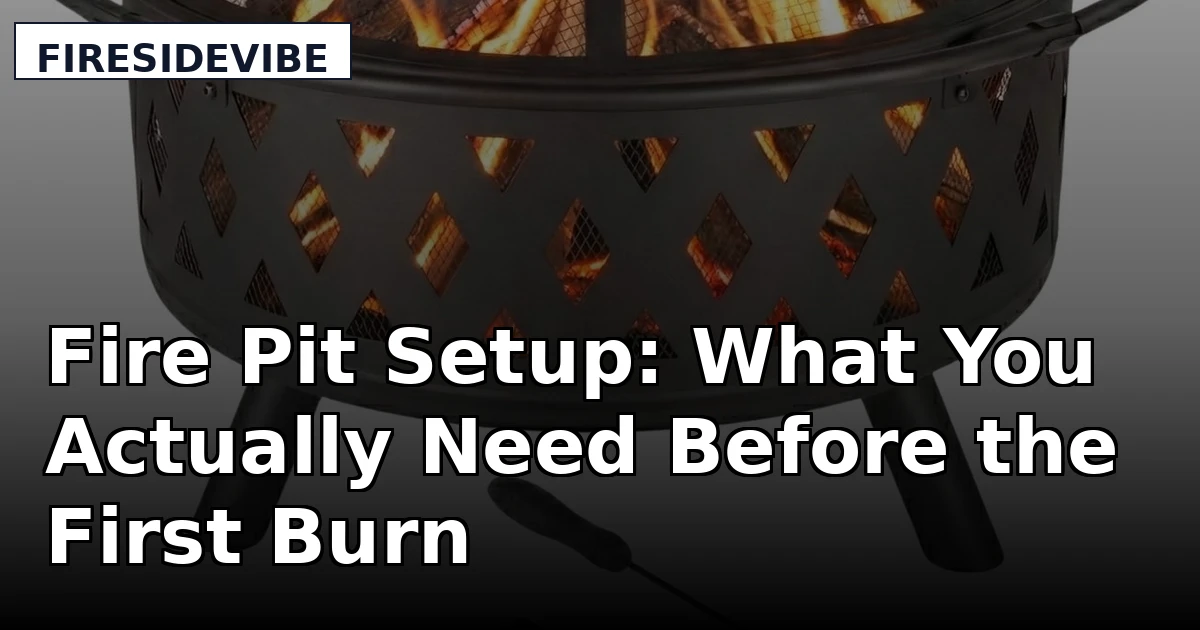
A fire pit setup is never just the pit. It is a small system of decisions that all show up on the same Saturday night: what holds the fire, what protects the surface underneath it, how close people can sit, and whether the smoke follows everyone around the circle. Get those right and the fire is the easy part. Get them wrong and you end up with a scorched deck board, a dead patch of lawn, and a bowl that rusts through before the second season.
I have installed enough of these to know the pit is usually the last thing that fails. The surface under it fails first, then the ground around it. This guide covers four pieces that solve those problems: a 32-inch round pit, the propane table for nights when nobody wants smoke, the mat that goes underneath, and the yard treatment for the digging animals that treat a fresh fire pit surround like turned soil.
Related: How to Pick a Fire Pit Size for Your Patio →
Quick answer
A fire pit setup comes down to four jobs, and most backyards need all four covered. You need something to contain the fire, protection for whatever surface sits under it, an honest decision between wood and propane, and a plan for the ground around the pit. For a typical backyard, a 32-inch round pit covers the fire, a heat barrier mat covers the deck or patio, a propane table covers the nights when smoke is the dealbreaker, and a yard deterrent covers the digging animals that ruin a fresh surround. Skip the surface protection and the pit turns into a repair bill.
4 useful options
| Model | Best fit | What stands out |
|---|---|---|
| Pure Garden Outdoor Fire Pit with Cross Weave Pattern, Black, 32-Inch | A round pit for a patio, gravel pad, or lawn edge | 32-inch round footprint with a cross weave pattern and black finish |
| Electactic 28" 3-in-1 Propane Fire Pit Table, 50,000 BTU | Patios where wood smoke is the problem | Propane table rated at 50,000 BTU, described as a 3-in-1 design |
| 48" Fire Pit Mat for Solo Stove Yukon - Round Under Grill Mat | Decks, pavers, and grass under a large round pit | 48-inch round mat sized for the Solo Stove Yukon |
| Armadillo Repellent Spray, Natural Armadillo Deterrent Concentrate 32 fl oz | Yards where digging animals are wrecking the surround | 32 fl oz natural concentrate deterrent |
The backyard pit: Pure Garden Outdoor Fire Pit with Cross Weave Pattern, Black, 32-Inch
Thirty-two inches is the number that matters here. A pit that size seats four to six people at a comfortable distance, which is most backyards. Go bigger and you need clearance most patios do not have. The cross weave pattern is a looks decision, not a performance one, and the black finish hides ash staining better than a light bowl does. What the listing name does not tell you is the steel thickness or whether a spark screen is included, and those are the two things I check first on any open bowl. A pit without a screen means embers leave the bowl, and embers are how a fire night turns into a deck repair. Verify both before you buy, and place the pit on level, non-combustible ground rather than directly on dry grass.
The gas alternative: Electactic 28" 3-in-1 Propane Fire Pit Table, 50,000 BTU
BTU is the headline spec on any gas pit, and 50,000 is a real burner rather than an ambiance flame. It also tells you something practical: the higher the rating, the faster the tank drains. The table format is the other draw. A flat rim around the burner gives you somewhere to set a drink, which is why gas pits show up on patios where a wood bowl would be awkward. Two rules come with propane and neither is negotiable. Never run one indoors, in a garage, or under a roof overhang, because propane burners produce carbon monoxide. And store the cylinder upright and outside, away from the pit itself. What the name does not tell you is how the ignition system is built or how the 3-in-1 functions are arranged, so read the product page before you commit.
The surface protector: 48" Fire Pit Mat for Solo Stove Yukon - Round Under Grill Mat
Heat, ash, and dropped embers all travel downward, and a deck, a paver patio, and a lawn each respond differently to that traffic. This is the cheapest insurance in the whole setup and the piece people forget until something underneath changes color. At 48 inches across it is sized for a large round pit, so measure your own bowl before ordering: a mat that is too small leaves the hottest part of the footprint exposed, and one that is oversized looks like a rug. It is a barrier, not a substitute for clearance. Keep the manufacturer's required distance between the pit and any structure, and remember that a mat under a wood pit still collects ash that needs to be cleared out.
The yard protector: Armadillo Repellent Spray, Natural Armadillo Deterrent Concentrate 32 fl oz
This is the unglamorous half of fire pit ownership. Armadillos dig for grubs, and a newly built surround, with its loosened soil and fresh mulch, is prime ground. They do not care that you just leveled the gravel. Treating the perimeter before the pit goes in is far easier than re-leveling a surround after a season of craters. Because it is sold as a concentrate, read the label for the mixing ratio and the application interval, and keep any spray off the fire bowl itself and away from the burn area. Heavy rain will shorten how long it stays effective, so plan on reapplying around the surround after big storms and after you top up the mulch. Deterrents are about making the yard less inviting, not about a permanent fix, and local wildlife rules vary by state.
Prices and availability may change. Confirm the current price, the dimensions, and the included accessories on the product page before you buy.
What actually matters in a fire pit setup
Steel gauge is the number that decides whether a pit is a decade purchase or a one-season novelty. Thin steel warps and rusts through; thicker steel holds its shape through weather and repeated burns. You cannot see gauge in a product photo, so read the material line on the listing, and treat any pit that does not list it as a question mark rather than a bargain. A pit that cannot survive a season of rain was a decoration, not a purchase.
Smoke behavior is the second thing. A conventional wood pit sends smoke wherever the wind takes it, which is frequently into the eyes of whoever is sitting downwind. Smokeless designs use a double wall and a secondary burn to feed air back into the fire and burn off much of that smoke, and that changes the entire experience of sitting around the circle. If smoke is why you stopped using your last pit, that design difference matters more than the shape of the bowl.
The spark screen is the third. An open bowl throws embers, and an ember landing on dry grass, a wood deck, or a chair cushion is how a good evening turns into a claim. A mesh screen or spark arrestor is the least expensive safety feature you will ever buy, and a pit without one is a pit you have to babysit.
For propane tables, the headline number is BTU, the rated heat output of the burner. A 50,000 BTU table throws genuine heat, while smaller units are mostly ambiance. BTU tells you roughly how much warmth the burner produces and how fast it consumes fuel, but it says nothing about how the table is built or how long the ignition will last.
Finally, the surface under the pit. Heat, ash, and dropped embers all move downward, and a deck, a paver patio, and a lawn handle that differently. None of them enjoy a hot bowl sitting directly on top of them.
How wood, propane, and the ground around the pit fit together
Wood is the experience. You get the smell, the crackle, the tending, and the smoke. Propane is the convenience. You get flame on demand, an off switch, and nothing in your hair or drifting into a neighbor's window. Neither choice is wrong, and plenty of backyards end up with both: a wood pit for the nights you want a real fire and a gas table for fifteen minutes of flame before bed.
The accessories are where setups usually fail. A mat under the pit costs a fraction of the pit and absorbs the heat and ash that would otherwise go into the surface below. Yard treatment handles the other kind of damage, the digging kind. Dealing with that before the pit goes in beats re-leveling a surround later.
The order you do things in matters more than the brand you pick:
- Decide whether you are a wood person, a propane person, or both, because that sets the footprint and the fuel storage.
- Measure the space and the seating. A 28 to 32 inch pit seats four to six people comfortably, and anything larger needs more clearance than most patios have.
- Choose the surface the pit will sit on, then choose the protection for it. A mat under a deck or patio pit costs less than replacing boards.
- Check the bowl material, the listed steel thickness, and whether a spark screen is included before you buy.
- Treat the ground around the pit before the first burn, not after the digging starts.
Practical guidance for the first burn
- Keep the pit on a level, non-combustible surface and follow the manufacturer's clearance distances from structures, fences, and low branches.
- Never use a propane fire pit table indoors, in a garage, or under a roof overhang, since propane burners produce carbon monoxide.
- Empty ash only when it is fully cold, and put it in a metal container rather than a paper bag or plastic bin.
- Store propane cylinders upright and outside, away from the pit, and check the hose and connections for cracks each season.
- Cover or store the pit and the mat through the wet months, because standing water and thin steel are how a two-season pit becomes a one-season pit.
- Reapply yard deterrent around the surround after heavy rain and after you add new mulch.
Which option should you choose?
Choose the Pure Garden Outdoor Fire Pit with Cross Weave Pattern, Black, 32-Inch when you want a round pit sized for a normal patio and you are happy to manage smoke the traditional way. Choose the Electactic 28" 3-in-1 Propane Fire Pit Table, 50,000 BTU when smoke is the dealbreaker, when the pit needs to double as a table, or when you want flame without tending a fire. Choose the 48" Fire Pit Mat for Solo Stove Yukon - Round Under Grill Mat when the pit sits on a deck, a patio, or grass and you want a barrier between the heat and the surface. Choose the Armadillo Repellent Spray, Natural Armadillo Deterrent Concentrate 32 fl oz when the ground around the pit is being dug up and you want to deal with it before you build.
None of these listings publishes steel gauge or burn data in the name alone, so treat material and sizing claims as things to confirm on the product page. Heat output, clearance requirements, and local burn regulations vary by yard and by county, and a propane table is a different animal from a wood pit in every way that matters for safety.
The bottom line
A fire pit setup is a sequence, not a single purchase. Get the pit right for the space, protect the surface underneath it, decide honestly between wood and propane, and handle the ground around the pit before the first burn. The pit gets all the attention, but the mat, the clearance, and the yard work are what keep the whole thing usable season after season. Check current Amazon price on each piece, confirm the dimensions against your own space, and read the safety documentation before the first fire.