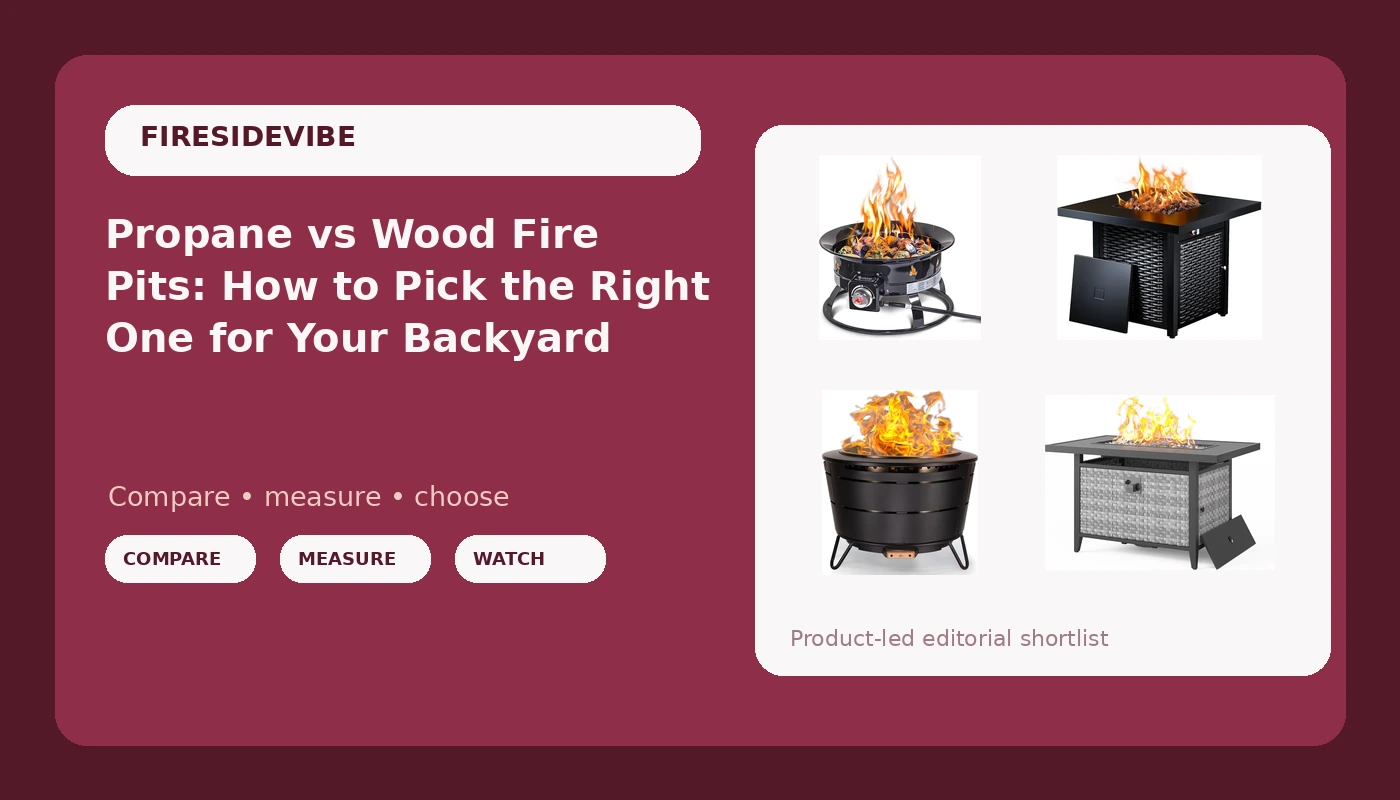
The propane vs wood fire pits question is really a question about your evenings. A wood pit gives you crackle, real flame, and radiant heat you can feel on your face; it also gives you ash, smoke, and a chore list. A propane pit gives you fire in about a minute, a clean shutoff, and no smoke in your hair; it also gives you a fuel tank to manage and a flame that behaves more like a gas appliance than a campfire. Neither fuel is the wrong answer. The wrong answer is buying the pit that fights your yard, your seating, or the way you actually host.
Related: Smokeless Fire Pit Guide: How Secondary Burn Actually Works →
Quick answer
Wood is the experience; propane is the convenience. Choose a wood-burning pit if you want real flame, you will source dry seasoned hardwood, and you have a spot with clearance and a non-combustible base. Choose propane if you want instant ignition, no ash, and a pit you can run during dry spells when open wood burning is restricted. The four options below cover both fuels: one wood-burning pit described as smokeless, and three propane pits split between a portable firebowl, a table-style pit, and a wicker table. Heat output is listed in BTU, and the size of your seating circle decides which one fits.
Four useful options
| Model | Best fit | What stands out |
|---|---|---|
| TIKI Reunion Smokeless Fire Pit, 27.5 in Wood Burning Fire Pit with Cover | Wood-burning backyard nights | 27.5 inch wood-burning pit described as smokeless, cover included |
| Outland Living Portable Propane Fire Pit, 19-inch, 58,000 BTU with Fire Pit Cover & Carry Kit, Smokeless Gas Firebowl | Camping, tailgating, decks, RV | 19 inch portable propane bowl, 58,000 BTU, cover and carry kit included |
| Ciays 28 Inch Propane Fire Pit CSA-Listed Outdoor Fire Pit Table, 50,000 BTU Steel Gas Fire Pits with Lid and Lava Rock | Patio and deck seating | 28 inch propane table, 50,000 BTU, CSA-listed, lid and lava rock included |
| 43 in Wicker Propane Fire Pit Table with Lid, 55,000 BTU | Lounge-style seating areas | 43 inch wicker table, 55,000 BTU, lid included |
The wood-burning option: TIKI Reunion Smokeless Fire Pit
Wood is the option that asks something of you. You need dry, seasoned hardwood, because green or damp wood produces far more smoke than any airflow design can burn off. You need a place to dump ash. You need a spark screen in place, especially over a deck or near dry grass, and you need to accept that a wood fire takes twenty minutes to get going and an hour to die down. What you get back is the part gas cannot copy: the smell, the sound, and heat that follows you as the fire shifts.
The portable propane option: Outland Living Portable Propane Fire Pit
Gas means no ash, no embers, and a shutoff valve. It also means a propane tank, which is the part most people forget to plan for. A portable bowl still needs a level, non-combustible surface, and it still needs clearance from anything that can melt, scorch, or warp. Because the fuel is propane rather than wood, a pit like this is often usable during burn bans that shut down open wood fires, but the rule is local, so confirm it before you plan a night around it.
The table-style propane option: Ciays 28 Inch Propane Fire Pit Table
The trade-off here is weight and permanence. A table-style pit is furniture. Once you place it, you are unlikely to move it every weekend, and that is fine if you have a patio or deck with a defined seating area. It is the wrong purchase if you wanted something to throw in the RV. It also sits at conversation height, which changes how a group uses the fire: people rest drinks on the edge and stay longer, which is the whole point.
The wicker table option: 43 in Wicker Propane Fire Pit Table
The cost of that footprint is space. A 43 inch table needs a seating area sized for it, and it will look oversized on a small city patio. Wicker also needs attention: keep it covered, keep standing water out of the base, and expect that any woven material left out through a full winter will show the weather. This is the pit you buy when the patio is already a destination.
Prices and availability may change. Product images, names, and retailer links are matched to verified listings. No current price, rating, stock status, or measured result is stated here without current evidence.
What actually separates these fire pits
Fuel decides the night. Wood gives you radiant heat and a smell that carries; propane gives you repeatability and a switch. Everything else is hardware, and the hardware is where cheap pits give themselves away.
Heat output, measured in BTU, tells you how much fuel the burner can consume, not how warm your knees will be. A propane pit rated at 50,000 BTU and one rated at 58,000 BTU will feel similar from six feet away; the difference shows up in wind and in how quickly the pit recovers. BTU is a rough proxy for size, not a promise about comfort.
Build material decides lifespan. Steel thickness, hardware quality, and finish matter more than a decorative surround. A base that rusts through in a season was a planter with a burner in it, and the same rule applies to wood pits: thin steel warps and burns through.
Smoke behavior decides whether people sit close. In a wood pit, look for a secondary burn design and a real spark screen. In a gas pit, smokeless is close to a given, since there is no wood to smolder, but the listing language still matters because it tells you what the manufacturer is claiming.
Footprint decides placement. A 19 inch bowl fits on a small deck. A 43 inch table needs a seating area built around it. Measure before you buy, and leave clearance from walls, railings, and anything overhead.
Safety certification and covers decide the boring parts you will appreciate later. A CSA listing on a gas unit, a cover included with the pit, and a non-combustible surface under it are not marketing extras. They are the difference between a pit that lasts and one that becomes a story you tell about your deck.
How to judge a fire pit before you buy
- Measure the seating circle first. Mark the spot, then measure the distance from the pit to the nearest chair, wall, and overhead structure. A pit that crowds the chairs will not get used.
- Decide the fuel honestly. If you will not stack and season wood, do not buy a wood pit. If you will not refill a propane tank, do not buy a gas pit.
- Match heat output to the space. Bigger is not automatically better. A high BTU burner in a small courtyard wastes fuel and aims a lot of heat at a fence.
- Check the steel and the hardware. Thicker metal and a real finish outlast a thin shell, and the cover matters as much as the gauge.
- Confirm the safety pieces. A wood pit needs a spark screen and a non-combustible base. A gas pit should carry a recognized listing and be checked for leaks before the first light.
Practical guidance for the first season
- Set the pit on a non-combustible surface: stone, concrete, or a metal stand. Deck boards and dry mulch are not that surface.
- Keep clearance from anything that can scorch: railings, siding, low branches, patio umbrellas, and furniture fabric.
- Burn dry, seasoned hardwood in a wood pit. Wet or green wood smokes heavily no matter how good the airflow design is.
- Store propane tanks upright, out of direct sun, and never inside a closed living space.
- Cover the pit when it is not in use, and empty ash only after it is fully cold. An ash bed can hold heat longer than you expect.
- Check local burn rules before you plan a fire night. Restrictions change with the weather, and they often treat wood and propane differently.
Which option should you choose?
Choose the TIKI Reunion Smokeless Fire Pit when you want the real thing: wood flame, crackle, and radiant heat, and you are willing to handle ash, fuel, and a spark screen. Choose the Outland Living Portable Propane Fire Pit when the fire needs to travel, whether that is a campsite, a tailgate, or a deck that cannot host a permanent pit. Choose the Ciays 28 Inch Propane Fire Pit Table when you want a fixed, CSA-listed gas pit at conversation height that doubles as a table. Choose the 43 in Wicker Propane Fire Pit Table when your patio already has a seating area and you want the largest footprint and the furniture-matching look in this group.
One caveat: everything here rests on listed specifications, stated BTU ratings, sizes, and included accessories, not on a measured burn test. Smoke behavior, actual heat reach, and long-term durability depend on your fuel, your placement, and your weather. Treat the specs as the starting filter and your own yard as the final one.
The bottom line
Wood is the experience and propane is the convenience, and the pit that fits your life is the one you will actually light. If you want crackle and radiant heat, the wood-burning option here is built around smoke management and comes with a cover. If you want fire in a minute with no ash, the three propane options split cleanly by job: a portable bowl for travel, a CSA-listed table for the patio, and a wicker table for a full lounge setup. Decide which one you are, camper or host, then buy the pit that matches.